Which Of The Following Functions Illustrates A Change In Amplitude . Period 2π/b = 2π/4 = π/2. The following is the graph of the function y = 2 sin ( x), which has an amplitude of 2: 📈Which of the following functions illustrates a change in amplitude from brainly.com Transformations and translations project #1: Thus, amplitude of the given function is 0. Y = 1 + sinxb.
What Happens When A Substance Undergoes A Physical Change
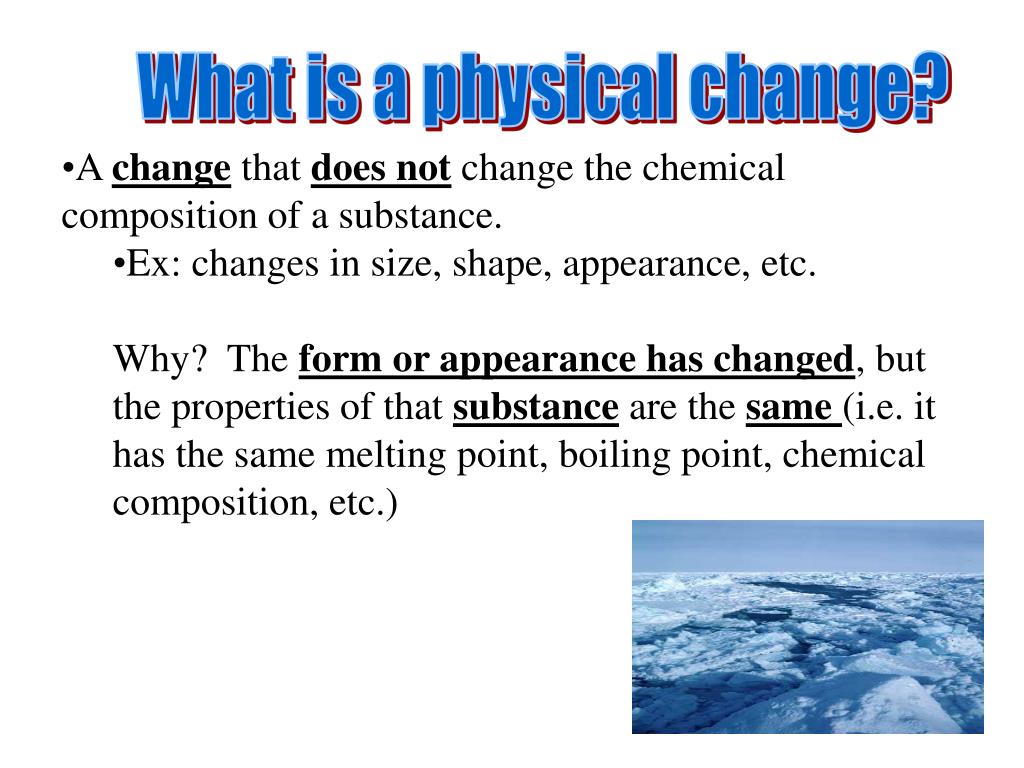
What Happens When A Substance Undergoes A Physical Change. When a substance undergoes the physical change from one state to another or a transition of matter form one state to another: Physical changes affect a substance’s physical properties but do not alter its chemical structure.
PPT Pure Substances vs. Mixtures Physical and Chemical Changes from www.slideserve.com
An ice cube can melt into liquid water, and then the liquid water can be frozen back into an ice cube. Chemical changes, on the other hand, are not reversible: Chemistry matter physical and chemical changes.
A Physical Change Is Any Change In A Substance’s Form That Does Not Change Its Chemical Makeup.
In phase changes the substance doesn’t change composition. No physical properties change, but the substance changes its identity. Chemistry matter physical and chemical changes.
The Chemical Reaction Produces A New Substance With New And Different Physical And Chemical Properties.
Danger nov 12, 2016 the way the molecules are arranged in the matter. Matter is capable of undergoing changes, which are classified as either physical or chemical. When a substance undergoes the physical change from one state to another or a transition of matter form one state to another:
Chemical Changes Are Also Called Chemical Reactions.
For instance, if you cut a piece of paper in. The particles of one substance are rearranged to form a new substance. If you think about some examples, this makes a lot of sense.
The Substance Will Change State Such As Melting, Freezing, Or Bending.
Matter is never destroyed or created in chemical reactions. What is changed when matter undergoes a physical change? This causes the molecules or atoms to move further apart or closer.
A Log Burned In A.
In a physical change, like a state change or dissolving, no new substance is formed. It will still be the same substance, it will just look different. If it were still the same substance then it would be a physical change, not chemical.


Comments
Post a Comment